
Project Overview
SLICE: Space Launch Impact on Climate and Environment
SLICE investigates the environmental and climate impacts of space launch systems, advancing research on emissions, atmospheric interactions and sustainable design. The project delivers essential insights to support European policies and trains a new generation of researchers to shape a more sustainable future for space transportation.
Space utilisation plays a crucial role in understanding climate change, but due to a drastic increase in launch rates, there is an urgent need to understand and mitigate potential environmental impacts of space activities themselves, particularly of launchers. However, large knowledge gaps persist for their operational phase from lift-off to landing/reentry. Here, the largest Global Warming Potential and Ozone Layer Depletion Potential are expected. Especially in the higher atmospheric layers, which are only accessed by launchers, potential impacts of emitted pollutants are amplified by very long retention periods and substance accumulation effects. To investigate the Space Launch Impact on Climate and Environment, SLICE will therefore develop a research and training programme that bridges the current divide between space engineering and climate science to close the gaps that exist in the Life-Cycle Analysis of space launch systems.
Thus, SLICE will contribute to advance the science of climate change by investigating the three most pressing research areas of this field: Launch Vehicle Emissions, Atmospheric Interaction & Climate Impact and System Analysis & Design. This will generate actionable insights, on which SLICE will develop solutions to reduce greenhouse gas emissions, accelerate the delivery of the Green Deal and establish an environmentally sustainable access to space. It’s the ambition of SLICE to generate desperately needed novel results, which will enable cutting-edge innovations. At the same time, SLICE is committed to training a new generation of highly skilled, resilient, and environmentally aware researchers. They will combine deep scientific knowledge with an ecodesign mindset and the ability to communicate across disciplines and sectors. These doctoral candidates will be uniquely prepared to shape a sustainable future for space transportation in Europe – technically, environmentally, and politically. SLICE directly supports the European Green Deal, ESA’s Agenda 2025, and will deliver crucial inputs for the EU Space Law and Product Environmental Footprint (PEF) regulations at European level, including the development of PEF Category Rules (PEFCR) for space.
Ambition
Our Mission and Objectives
The overarching objective of SLICE is to support the EU’s commitment to make Europe the first climate-neutral continent by 2050. Therefore, SLICE will contribute to advance the science of climate change by investigating the impact of space launches on the atmosphere and thus, the climate. This will generate actionable insights, on which SLICE will develop solutions to reduce greenhouse gas emissions and accelerate the delivery of the Green Deal and establish an environmentally sustainable access to space. Detailed analysis of the involved challenges revealed the most pressing issues that are represented by the following specific sub-objectives of SLICE:
- A database of emissions of launchers during the operational phase from lift-off to landing/re-entry, using synergetic and complementary experimental and numerical approaches in WP2.
- Tools developed to assess the interaction between the emitted pollutants and the surrounding atmosphere and the resulting climate impact (WP3) based on various market development trajectories (WP4).
- Methodologies to implement environmental considerations in early phases of launcher system design while ensuring compatibility with the full LCA of launchers to consider all development phases (WP4).
- 18 creative, entrepreneurial, innovative & resilient PhDs via an international, inter-sectoral and multi/ inter-disciplinary training (WP5), able to generate economic and social benefit in face of current and future challenges.
- Concrete actionable recommendations for stakeholders to minimise the environmental and climate impact, especially targeting launch service providers and the industrial supply chain as well as policy makers (WP6).
Approach
Interdisciplinary Research and Training Architecture
The main idea behind SLICE is to bridge the current divide between space engineering and climate science to close the gaps that exist in the LCA of space launch systems. The structure of the SLICE research and training programme is arranged around the 3 most pressing research areas of this field: Launch Vehicle Emissions, Atmospheric Interaction & Climate Impact and System Analysis & Design. These areas will be organised into a set of interconnected technical WPs and complemented by an intensive programme of training courses and network-wide training events (see figure below). Each DC will work within a high-level Individual Research Project (IRP) with strong interactions to other DCs and side-by-side with lead scientists at world-leading institutions. This will be reinforced by secondments to universities, research centres, companies and (inter-)governmental space authorities across disciplines and sectors for the exchange and sharing of ideas and methodologies. The consortium will provide a supportive and enthusiastic environment for the DCs to perfect research skills acquired in training courses by putting them into practice. The quality of the supervision is a key element of the project and emphasis will be put on dedicated arrangements (cf. section 1.4). The network-wide activities will allow the dissemination and transfer of knowledge to other DCs and to the wider scientific and industrial community. It will also reinforce cooperation and create synergies to facilitate future partnerships between the DCs. These networking activities will be key to open up career opportunities across the range of scientific disciplines and sectors.
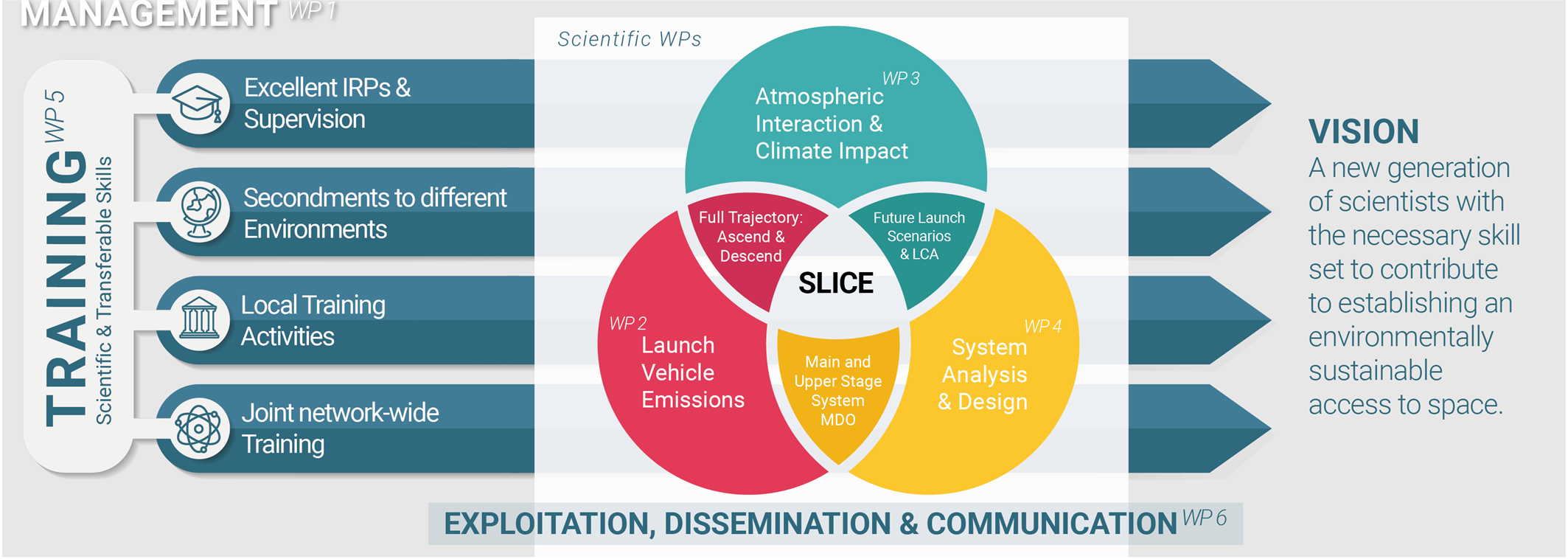
The figure above displays the structure of SLICE with focus on the WPs and their interaction. It also shows how the DCs evolve through the training and their IRPs. All WPs will be conducted in parallel. This is important, as the IRPs are highly interconnected and rely on a steady mutual ex-change of information (cf. section 3.1.6). All IRPs are specifically tailored for DCs and coordinated across the consortium. Together, they enhance our understanding of the science on SLICE within a combination of perspectives and disciplines. In WP2, Launch Vehicle Emissions originating from both launcher propulsion and demise during atmospheric re-entry of upper stages will be determined. DC1 will compute the emission composition of the combustion gas at the outlet of a CH4/O2 Liquid Rocket Engine (LRE), which is one of the most important propulsion systems for current and future launchers. It will incorporate a numerical reduction technique for combustion chemistry developed by DC2. Experimental data to validate the numerical results will be generated by DC3. For re-entry, DC5 will model ablation emissions with numerical simulations, which will be validated with experimental data generated by DC6. DC4 will put particular focus on the behaviour of composite materials during re-entry, to account for their rising importance for upper stages. The re-entry studies will concentrate on upper stages, which result in ca. 80 % of the total re-entry mass[1]. Nevertheless, transferability of approaches and results to satellites will be carefully attended to, guided by dedicated partners such as ADS. In WP3, the Atmospheric Interaction & Climate Impact of these emissions will be investigated. DC8 will model the evolution of the propulsion emissions through the nozzle and in the near field of the wake, focusing on the flow mechanics and chemical reactions as the plume interacts with the surrounding atmosphere. DC7 will further investigate the evolution of the exhaust plume emissions along relevant flight trajectories, to generate a spatial and temporal distribution of the propulsion emissions. Analogue to this, DC9 will investigate the evolution of the re-entry-induced emissions along relevant descend trajectories. DC10, DC11 and DC12 will use the emission data as inputs to model the impact on atmospheric composition and climate, using the global climate models WACCM6-CARMA, SOCOLv4 and LMDZ-INCA respectively to ensure model independency. To advance these models, DC12 will conduct experiments on the alumina physico-chemical and kinetic properties under the stratospheric conditions. In WP4, System Analysis & Design, DC13 to DC16 will investigate the influence of various relevant launcher architectures and operational profiles on the atmospheric and climate impact. DC13 will analyse overall system architectures and operating scenarios to enable environmental impact predictions during conceptual design. DC14 will develop a multi-fidelity, multi-disciplinary launch system optimisation tool that focuses on operational emissions. While DC15 will focus on the environmental impact resulting from (especially propulsive) first stage recovery strategies to facilitate their reusability, DC16 will investigate the environmental impact resulting from the reuse of upper stages, focusing on re-entry and recovery strategies. DC17 and DC18 will ensure that all the work is compatible with an implementation into the holistic LCA of launchers. DC18 will develop a space sector-specific LCA framework and novel impact assessment methods, utilising best practices from other sectors. DC17 will implement a holistic methodology for the LCA of launchers into the LCA tool currently under development at US. The 3 technical work packages are complemented by work packages for Management (WP1), Scientific and Transferable Skills Training (WP5) and Exploitation, Dissemination and Communication (WP6).
This presented approach is reflected by the careful selection of SLICERs that are leaders in these domains: academic institutions, agencies and companies in space engineering as well as experts in environmental and climate sciences. SLICE will involve 3 dedicated partners from Switzerland that bring in special expertise that is not existent within the EU and that will employ one DCs each with funding provided by SERI. SLICE was intentionally build as a very large consortium to form a critical mass that drives the green transition. This diverse consortium yields interconnections that transcend the individual capacities of its components, creating a collaborative synergy greater than the sum of its parts. This diversity of capabilities and state-of-the-art infrastructure, coupled with their synergistic integration, paves the way for advances in comprehending the Space Launch Impacts on Climate and Environment (SLICE), aiding the development of future space access systems and operations, and fostering a deeper understanding of its implications. These collaborative effects reverberate across the entire network and will have a direct impact on the scientific outcomes, as well as the training, secondment, and dissemination activities.
[1] Pardini, C. et al.: The risk of casualties from the uncontrolled re-entry of spacecraft and orbital stages, J. Space Safety Engineering, 11-2, 2024, Link.
Work Packages
Structure and Coordination of the Research Programme
The SLICE project is organised into a set of interlinked Work Packages that together ensure effective management, high-quality scientific research, and impactful dissemination of results. Each Work Package addresses a specific thematic or operational component of the project, ranging from coordination and emissions analysis to atmospheric impact assessment, system design, skills development, and communication.
WP1 • Management
Objectives
To ensure the overall operation of the project including technical, administrative and financial aspects, in order to guarantee that the European ComMission (EC) officers are informed about the project progress as well as the achievement of milestones and deliverables on schedule.
Leader
Contributors
All Beneficiaries
Tasks
- T1.1 Project planning, execution, reporting: Network work plan and tools for planning and monitoring project activities with Work Package leaders; Recruitment of Doctoral Candidates (DCs); Deliverables, periodic and final reports for EC; Progress and quality monitoring of research and training; Organisation of the board of representatives (BOR) and the executive board (EB) meetings; Monitoring external activities and events which may have impact and create opportunities; Communication within/outside SLICE; Risk monitoring.
- T1.2 Financial & legal administration: To monitor the financial & legal management and claim submissions & distribution of finances agreed by the Grant and Consortium Agreement.
- T1.3 Data management: Creating, updating and executing the Data Management Plan (DMP), establishment of internal data sharing platform incl. backups and protocols for data sharing, all in adherence of the FAIR principles.
WP2 • Launch Vehicle Emissions
Objectives
A database of emissions of launchers during the operational phase from lift-off to landing/re-entry.
Leader
Contributors
Tasks
- T2.1 Estimation and modelling of emissions for CH4/O2 combustion in LRE combustion chambers (Leader: Deutsches Zentrum für Luft- und Raumfahrt e.V.): Combining experimental data (DLR) & numerical simulations from ISAE using reduced scheme from ULB, emissions of CH4/O2 combustion in representative conditions for liquid rocket engines (LRE) will be characterised and suitable numerical tools for their estimation developed. Diagnostics will generate validation data as input for Tasks T2.3, T3.1 and T3.2, incl. spectroscopy, infrared visualization, schlieren, and mass spectrometry on gas probes taken from the flow. Reduction schemes will be applied to global scheme for CH4/O2 combustion, representing LRE operative conditions and implemented in the LES code AVBP.
- T2.2 Estimation and modelling of emissions from ablation and demise of material during re-entry (Leader: University of Stuttgart) : Emissions characterisation from ablation and demise of metals (Aluminium and Titanium) and composite structures (CFRP and CFC), focusing on typical break-up altitudes (70-85km), where significant chemical effects of material in exchange with the high enthalpy air flow field are expected. Material degradation experiments in plasma wind tunnels with available diagnostics and new methods developed in T2.1. Post-test inspection data will validate numerical simulations. The approach of complementary experiments and modelling is then extended and tailored to more complex materials, i.e. CFRP and CFC.
- T2.3 Provide data and models of emissions to be used by design tools and Life-Cycle-Analysis (LCA) (Leader: Institut Superieur de l’Aeronautique et de l’Espace): The developed methodology for liquid rocket engine (LRE) combustion species simulations and estimation will be used to investigate the impact of different operating conditions (pressure and fuel-to-oxidizer ration (O/F)) over the emissions. Results of parametric studies will provide a correlation that enables LCA and design analysis in Work Package 4 (WP4). Data extracted from experiments in wind tunnels and associated simulations and testing on different materials will be combined in a novel dataset on material demise and evaporation to be used in LCA in WP4.
WP3 • Atmospheric Interaction & Climate Impact
Objectives
Tools developed to assess the interaction between the emitted pollutants and the surrounding atmosphere and the resulting climate impact.
Leader
Contributors
Institut Supérieur de l’Aéronautique et de l’Espace (ISAE)
Consejo Superior de Investigaciones Científicas (CSIC)
Deutsches Zentrum für Luft- und Raumfahrt (DLR)
Technische Universität Dresden (TUD)
Institut Pierre-Simon Laplace (CNRS/IPSL)
ASTOS Solutions GmbH (ASTOS)
ArianeGroup (AG)
MaiaSpace (MAIA)
Physikalisch-Meteorologisches Observatorium Davos (PMOD)
Paul Scherrer Institut (PSI)
University of Leeds (UL)
Centre Euopéen de Recherche et de Formation Avancée en Calcul Scientifique (CERFACS)
Tasks
- T3.1 Emissions/Atmosphere Interaction (Leader: Centre Euopéen de Recherche et de Formation Avancée en Calcul Scientifique): In this task the flow in the nozzle and the near wake will be studied, including real mixture composition, reactivity and acoustics, using inlet flow characteristics from Work Package 2 (WP2), Tasks T2.2 and T2.3. Validation with experimental data from Task T2.1. Far wake and plume along the trajectory will be simulated to investigate the evolution of pollutant species for propulsive ascent/descend and re-entry, latter in close coordination with Task T2.2. Results serve Task T3.3 to update the existing emission databases and to parameterise near wake processes in global models.
- T3.2 Chemical lab experiments (Leader: University of Leeds): To measure the missing physico-chemical and kinetic parameters related to alumina particles under the stratospheric conditions, we will perform a series of laboratory experiments in a flow tube and microscope stage apparatus at UL and ambient pressure X-ray photoelectron spectroscopy facility (XPS) at PSI. The obtained information will be used to upgrade the participating global models in T3.3 as well as contribute to the NASA Jet Propulsion Laboratory (JPL) and International Union of Pure and Applied Chemistry (IUPAC) databases.
- T3.3 Preparation of global models and sensitivity tests (Leader: Institut Pierre-Simon Laplace): The three global models (SOCOLv4, WACCM6-CARMA and LMDZ-INCA) will be set up for the planned experiments and modelling groups will learn from each other by exchanging information on chemical reactions, parameterizations, etc. Sets of sensitivity tests will be performed, using the available rocket emission databases, focusing on various fuel types, emission profiles, and treatment of alumina and black carbon. Parameterization of the near-field processing of rocket plumes will be developed and tested in models, based on the incomes from Task T3.1.
- T3.4 Impacts on atmospheric composition, dynamics, and climate (Leader: Physikalisch-Meteorologisches Observatorium Davos and World Radiation center): Model upgrades and simulations as well as the main sets of simulations, based on updated emission inventories (WP2) and future scenarios (WP4) will be used to analyse space launch impacts on atmospheric chemistry at a variety of temporal (hours to decades) and spatial (regional to global) scales. Analysis of changes, resulting from modulation of atmospheric composition and from direct emissions of radiatively active species (alumina, water vapor, black carbon, CO2), on impacting the energetic balance of the climate system via changes in radiative forcing, the large-scale atmospheric circulation, and surface climate. Data and results will flow into the development of the Life-Cycle-Analyis (LCA) framework in WP4.
WP4 • System Analysis & Design
Objectives
Methodologies to implement environmental considerations in early phases of launcher system design while ensuring compatibility with the full LCA of launchers to consider all development phases.
Leader
Contributors
Office national d’études et de recherches aérospatiales (ONERA)
Indra Deimos (DEIMOS)
ArianeGroup (AG)
Deimos Space (DES)
MaiaSpace (MAIA)
Centro Italiano Ricerche Aerospaziali (CIRA)
University of Stuttgart (US)
Technische Universität Dresden (TUD)
ASTOS Solutions GmbH (ASTOS)
MT Aerospace AG (MTA)
Politecnico di Torino (POLITO)
Paul Scherrer Institut (PSI)
Tasks
- T4.1 Multi-fidelity and multi-disciplinary design of future sustainable space transportation systems (Leader: Politecnico di Torino): This task aims at developing highly integrated multi-disciplinary and multi-fidelity methodologies and tools to enable the inclusion of emissions estimation at different stages of the vehicle design maturity. Particularly, this will include environmental impact as a new discipline in the multidisciplinary design process, coupling legacy disciplines like propulsion, trajectory, aerodynamics and structure and implementing a multi-objective constrained closed system design optimisation.
- T4.2 Concept of Operations of future sustainable space transportation systems (Leader: Deimos Engineering and Systems S.L.U.): This task aims at developing methodologies and tools that will allow to define the Concept of Operations (CONOPS) of the launch mission and conduct the sizing/definition of subsystem or elements for different competing CONOPS.
- T4.3 Methodologies and tools for Life-Cycle-Analysis (LCA) of future sustainable launch vehicles (Leader: Paul Scherrer Institute): The ultimate goal of this task is to perform LCA of future space transportation systems to inform decision makers and society on related environmental impacts. A comprehensive LCA framework including new impact assessment methods will allow this.
WP5 • Scientific & Transferable Skills Training
Objectives
Organisation, coordination, control and supervision of joint and local training activities planned in the network. Verification of effectiveness of training. Elaboration and control of the Career Development Plan of every Doctoral Candiate.
Leader
Contributors
All Beneficiaries
Tasks
- T5.1 Organisation and supervision of network-wide training activities (Leader: Technische Universität Dresden): Organisation and supervision of all joint training activities. The host institution will be in charge of the local organisation, while TUD supports coordination, control and information of these events in the consortium.
- T5.2 Organisation and supervision of local training activities (Leader: Ecole Polytechnique Fédérale de Lausanne): Each institution is responsible for their local training. After completion of a local training event, EPFL will collect the information about the outcomes of these activities and potential improvements and will inform the consortium and the European Commission (EC) about their results and achievements.
- T5.3 Supervision of secondments (Leader: Ecole Polytechnique Fédérale de Lausanne): EPFL will be in charge of monitoring the timeliness, progress and quality of the secondments of all DCs to the academic and industrial partner organisations. Collecting information and secondment reports to provide feedback to the Work Package (WP) leaders about the results.
- T5.4 Elaboration of Career Development Plans (CDPs) (Leader: Technische Universität Dresden): A CDP will be developed with each individual Doctoral Candidate (DC). Each DC supervisor will be responsible for mentoring their DCs in developing this plan. Once this CDP is completed, the document will be sent to TUD for their supervision and submission to the EC. CDPs will be monitored and a final version produced in year 4 for each single DC.
WP6 • Exploitation, Dissemination & Communication
Objectives
Dissemination to and communicating with the general public and stakeholders. Networking within the project and with stakeholders as well as related activities. Exploitation of research results including the utilisation and management of IPRs.
Leader
Contributors
All Beneficiaries
Tasks
- T6.1 Dissemination (Leader: Technische Universität Dresden): Further develop, update and internally communicate our Dissemination Strategy.
- T6.2 Communication (Leader: University of Strathclyde): Update, manage and distribute our Communication Strategy. Monitor all Communication activities regarding effectiveness, adjustment of activities if needed.
- T6.3 Exploitation (Leader: Deimos Engineering and Systems S.L.U.): Identification and evaluation of Intellectual Property (IP) and transfer to individual research projects (IPRs) such as patents, licenses, trademarks and copyrights. Utilising results in further research activities, extending links to funding organisations, outreach to professional associations and creating links to political stakeholders in accordance to the exploitation strategy.